A new Bryden Wood *identity* \\Martin Wood
Every identity change is a question as much as a statement. The question is: does the way we present ourselves reflect who we actually are?
The honest answer is that it didn't, not fully. We had outgrown the identity that had served us well. The work we do today: across clean tech, life sciences, energy, and data centres, grounded in Design to Value methodology, needed an identity that could carry it.
The new identity is an attempt to bring the outside into alignment with the inside. Director Martin Wood recorded this short film to explain what has changed, and why.
How the work has evolved:
Bryden Wood starts every challenge the same way: by asking the right questions. The process begins with a problem statement – not 'what has the client asked for' but 'what are they trying to achieve'. That distinction has always mattered. Today, we are as likely to advise on whether to build as on how to build, and we are at our best when we help clients define the right brief from the start.
What has changed is the scale and nature of the challenges we are being asked to address. The work is now concentrated in three areas: accelerating decarbonisation, deploying new technologies, and designing and delivering critical infrastructure. Across clean tech, life sciences, energy, and data centres, clients are scaling up – moving from one-off projects to industrialised programmes, deploying new technologies, meeting ambitious decarbonisation goals, and building the infrastructure that powers the modern world.
That shift in the nature of the work has sharpened our sense of purpose. Our role is not to deliver a project and move on. It is to transform ideas into working delivery systems – through a process called productisation, in which technology solutions are developed as repeatable, scalable products rather than bespoke projects. The difference matters enormously in sectors where the challenge is not to solve a problem once, but to solve it at scale, consistently, and fast.
What the new symbol means
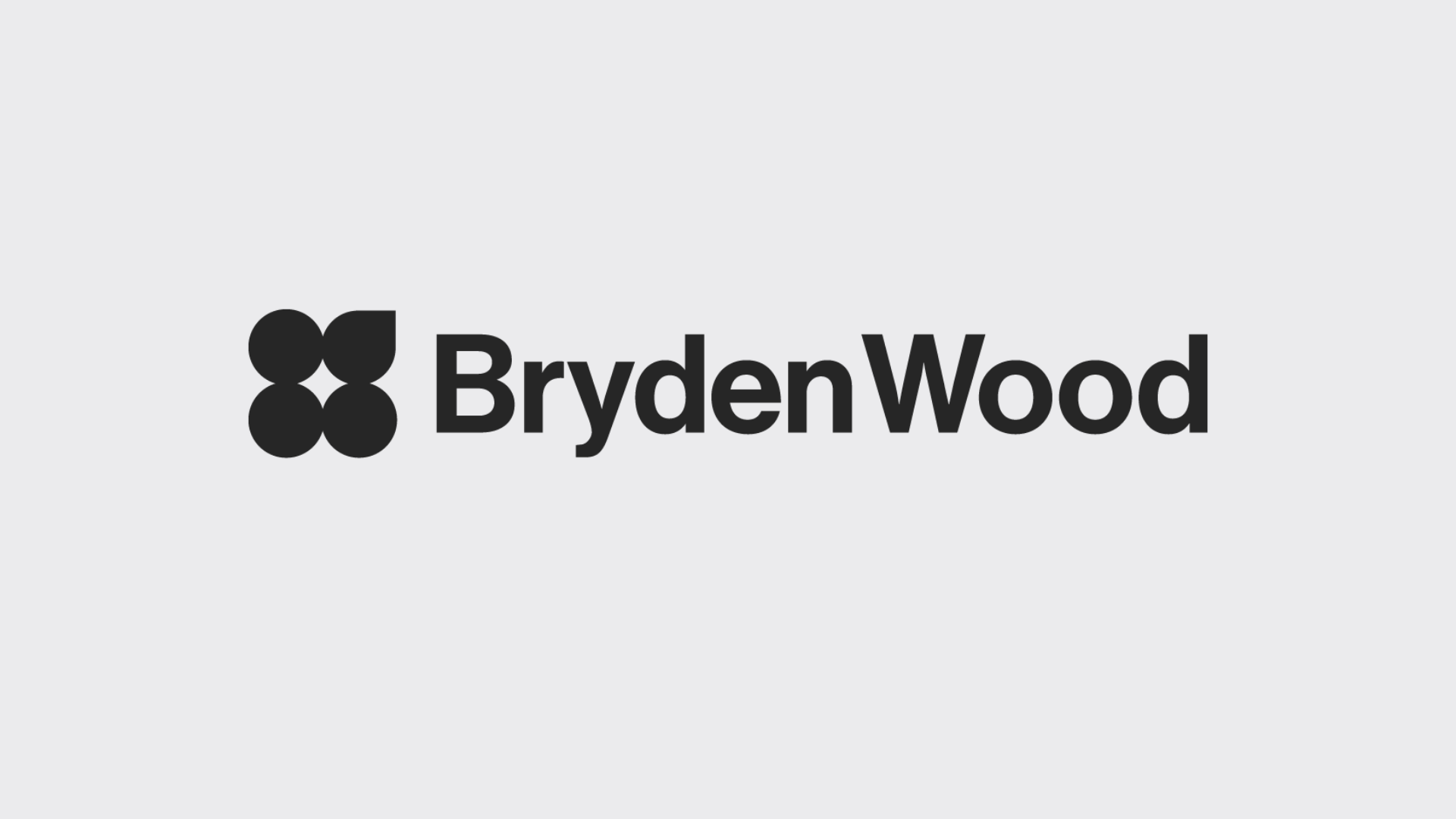
The Bryden Wood isotype: four overlapping circles, with the upper-right form carrying a directional accent, was designed to reflect the way we actually work.
The overlapping forms express integration. We operate as fully integrated, transdisciplinary teams: architects, engineers, strategists, and technical specialists working together rather than in sequence. The shapes in the symbol overlap and remain in constant relation to one another – disciplines, projects, and people moving fluidly across domains, not handing off between them.
The upper-right circle introduces direction. Its form carries a subtle forward movement – a symbol of progress, of higher impact, higher value, and the capacity to go beyond the conventional. At the centre of the composition, a white space remains: room for creative thinking, a space for innovation.
Bryden Wood's purpose – advancing the world by design – speaks directly to the projects we choose and the impact we want to have: on climate, on energy, on healthcare, and on the data infrastructure that connects it all.