
Mechanical + Electrical Engineering: less intervention, better performance
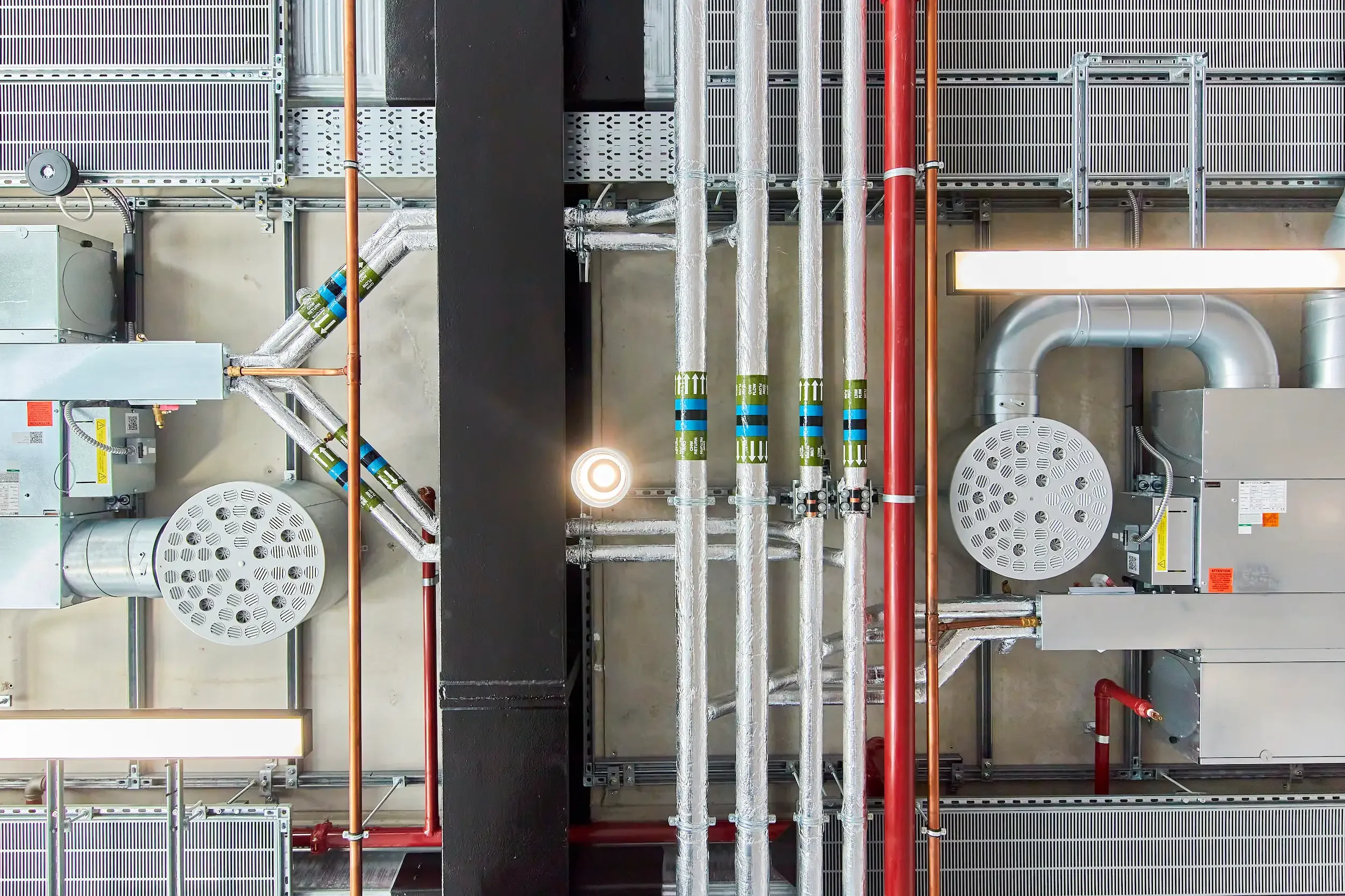
Most M&E engineering happens too late. The mechanical and electrical systems are designed around a structure that has already been determined, then coordinated into whatever space remains, then value-engineered when the costs come in. The result is buildings with more intervention than they need – more plant, more distribution, more maintenance, more energy consumption – because the M&E logic was never part of the original design thinking.
At Bryden Wood, M&E engineering starts at the same moment as everything else. Our mechanical and electrical engineers are part of the integrated design team from day one, alongside architects, structural engineers, and sustainability specialists, working from the same model, toward the same problem statement. The goal is not to fit M&E into a building. It is to design a building where the M&E requirements are minimised by the architecture and structure around it.
Design to Value is the methodology that drives this. By analysing energy use, system performance, and carbon impact from the earliest design stages – using sophisticated analytical tools to quantify precisely what a building's heating, cooling, lighting, power, and ventilation demands will be – we can make data-driven decisions about M&E systems before they are specified, not after. The result is buildings that are leaner, more efficient, and less dependent on mechanical intervention to perform.

Where this approach has its greatest impact is in the application of DfMA to M&E design. Wherever possible, we design M&E systems for factory prefabrication – from large primary plant modules to sub-assemblies of pipework, cabling, and distribution – so that site installation becomes a process of assembly rather than construction. This reduces programme time, improves quality control, and eliminates the coordination failures that typically occur when M&E trades are working in sequence rather than in parallel. A 3D M&E engineering model is established at the strategic design stage and carried all the way through to the point where the installing contractor adopts it directly for installation.
This capability is particularly well developed in our data centre practice, where M&E design is the critical path of the entire project. Power and cooling systems in a data centre are not building services in the conventional sense – they are the primary function of the building, and every architectural and structural decision must serve them. Bryden Wood's integrated approach, combining mission-critical M&E design with reference design methodology and DfMA procurement strategy, allows data centre clients to deploy consistently and at pace, with 40% IT yield from total building footprint as a demonstrable outcome of the approach.
Our M&E teams offer deep experience across healthcare, pharmaceutical, commercial, education, aviation, and data centres. They bring the same rigour to a hospital ward as to a hyperscale data centre hall: understand the requirement first, then design the minimum necessary intervention to meet it with precision.
Next: Process Engineering
Previous: Civil Engineering