New Hospitals Programme

The National Audit Office estimates that schemes fully adopting Bryden Wood’s Hospital 2.0 approach would cost 25% less and take 20% less time to build than under traditional design and construction approaches – the equivalent of four hospitals for the price of three.

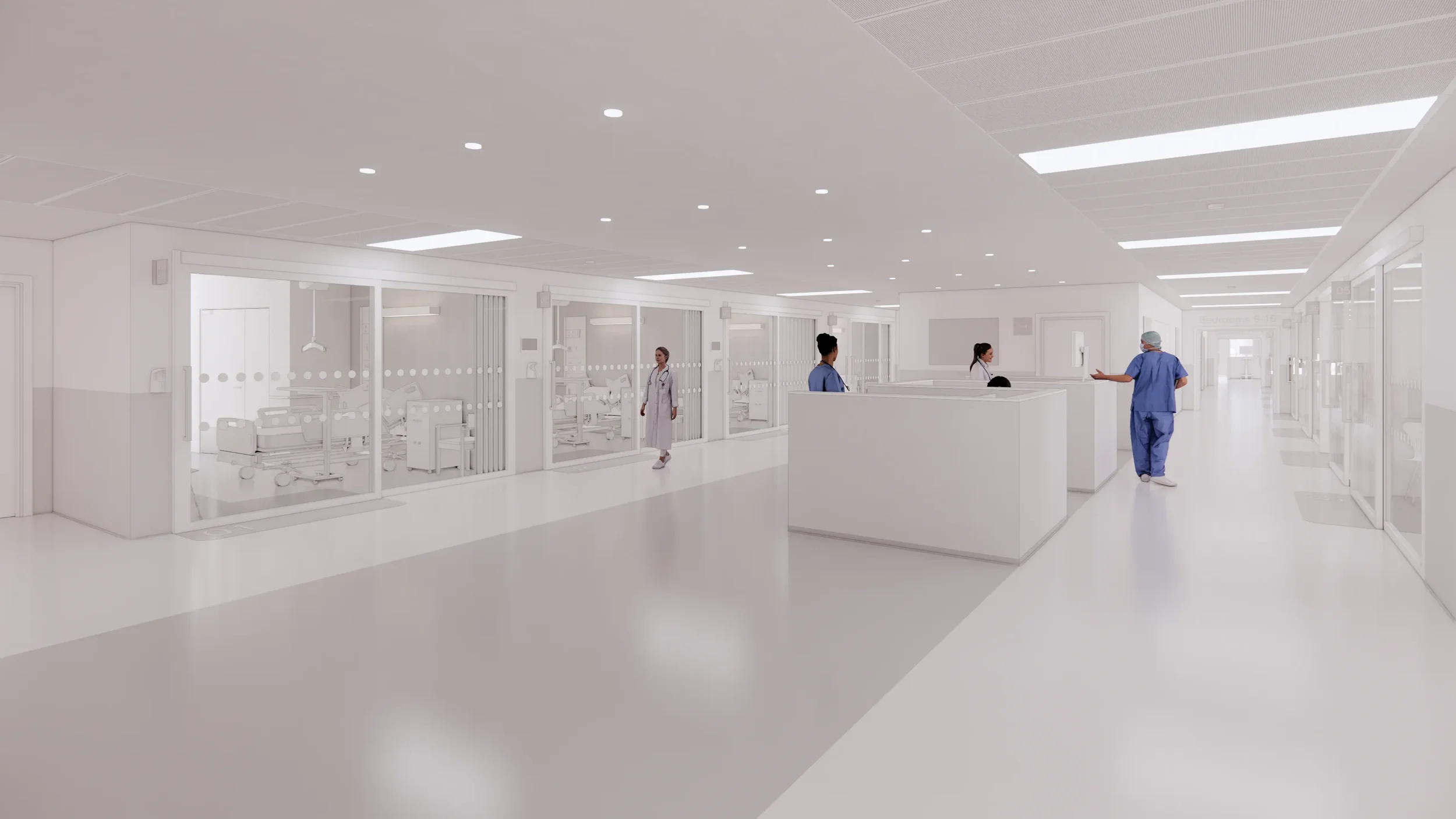
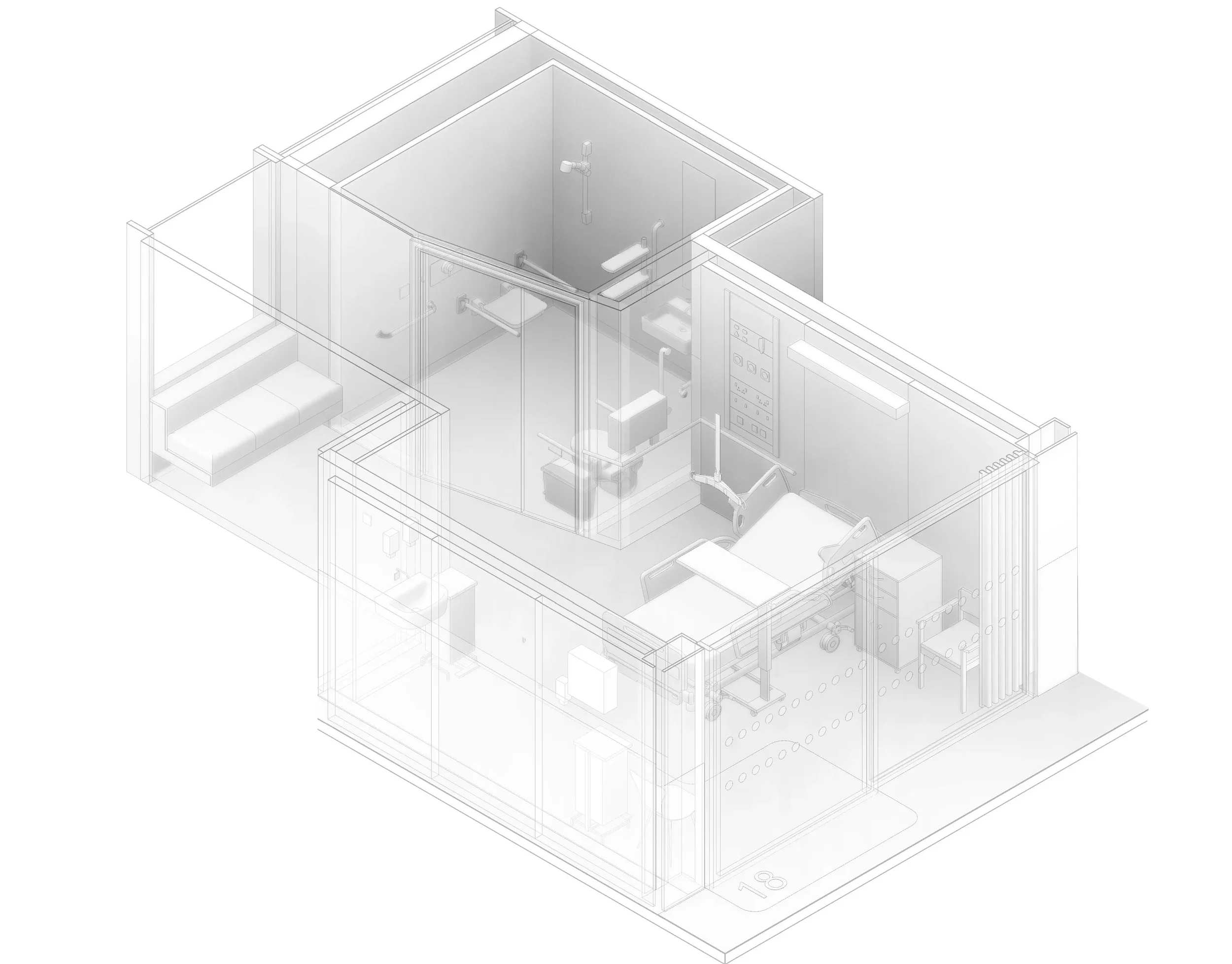
Bryden Wood developed Hospital 2.0 – a standard model for the 40 new hospitals commissioned across the UK by 2030 – as part of the New Hospitals Programme for NHS England. Built on Modern Methods of Construction, the model is scalable, configurable, and designed to deliver up to 25% cost reduction and 20% programme reduction against traditional design and construction approaches.
Project details:
-
-
-
Hospital 2.0 has been tested on key pathfinder schemes and delivers measured productivity gains of up to 30%, cost reductions of up to 25%, and programme reductions of up to 20%.
Not every scheme will be suited to full application – but every scheme can benefit from its core principles.
Bryden Wood’s integrated design team developed Hospital 2.0 as a standard model for the New Hospitals Programme – a government-backed initiative to deliver 40 new hospitals across the UK by 2030. The model applies Modern Methods of Construction to create a scalable, configurable hospital typology that can respond to the specific requirements of individual NHS trusts while maintaining the consistency needed to support standardised, repeatable manufactured solutions.
At the centre of Hospital 2.0 is a Reference Design developed in collaboration with a wide range of clinical and technical stakeholders. This design captures best practice in clinical space planning, optimising adjacencies between departments to create more compact facilities with less circulation space. The result is better patient journeys, reduced staff travel distances, and a stronger net-to-gross area ratio – all of which contribute to lower capital and whole-life costs without compromising clinical outcomes.
Bryden Wood tested the Hospital 2.0 strategies on key pathfinder schemes, measuring building efficiency improvements across the programme. The benefits of the standard model include productivity gains of up to 30%, cost reductions of up to 25%, and programme reductions of up to 20%. These gains are achieved through the closer integration of optimised clinical areas with the circulation and technical services that support them.
The Reference Design combines clinical best practice with digitally enabled efficiency and flexible deployment. It can be scaled to reflect local population and healthcare needs, reconfigured to suit site conditions, and adapted to support local supply chains. Not every scheme within the programme will be suited to the full application of Hospital 2.0 – but every scheme can benefit from its core principles.
Hospital 2.0 was tested on pathfinder schemes before it was presented as a programme standard. Bryden Wood's model demonstrates that standardisation and clinical excellence are not in conflict. They are the same goal, pursued by the same means.