Elizabeth Line Station Cladding
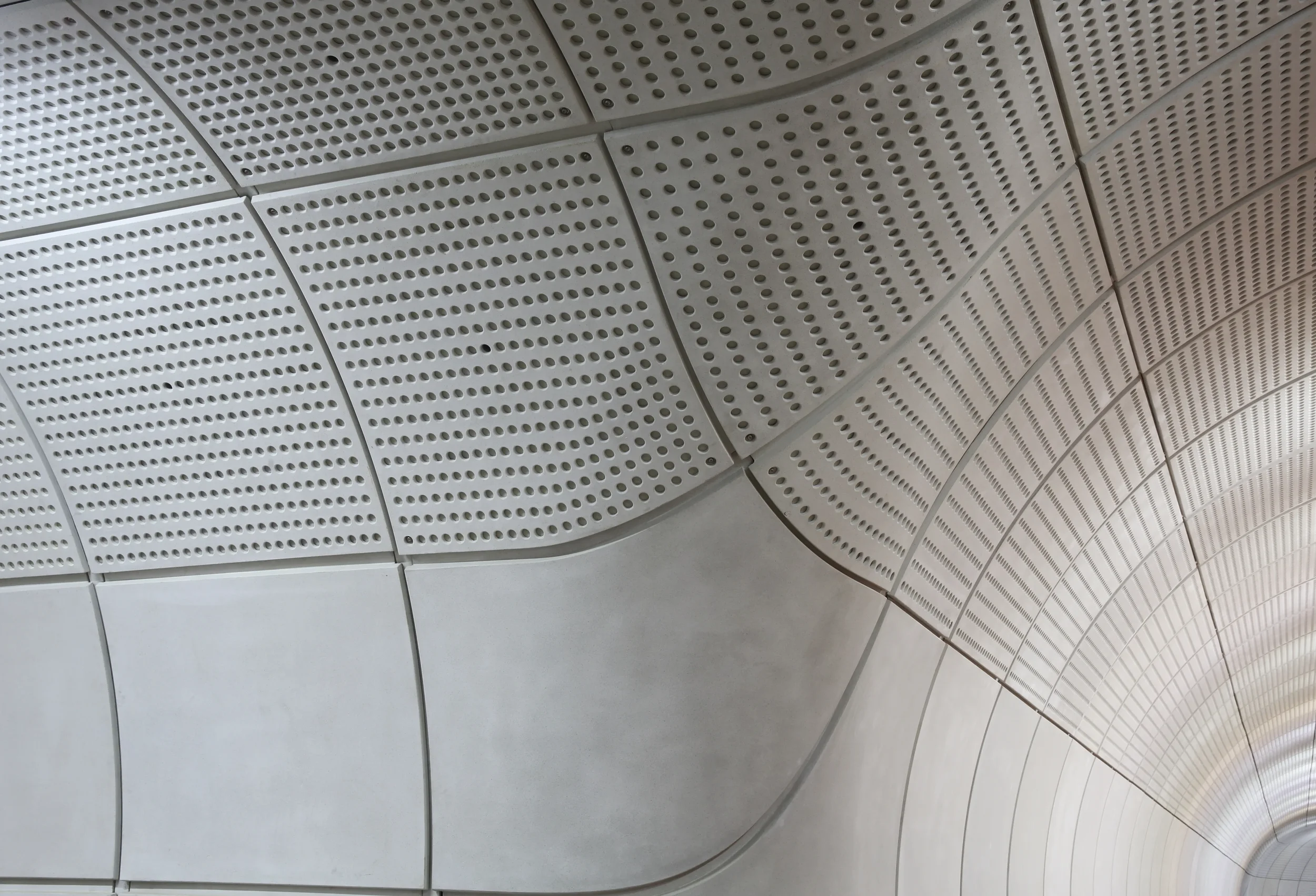
The cladding system Laing O'Rourke adopted as the standard for the Elizabeth Line – designed and delivered by Bryden Wood.


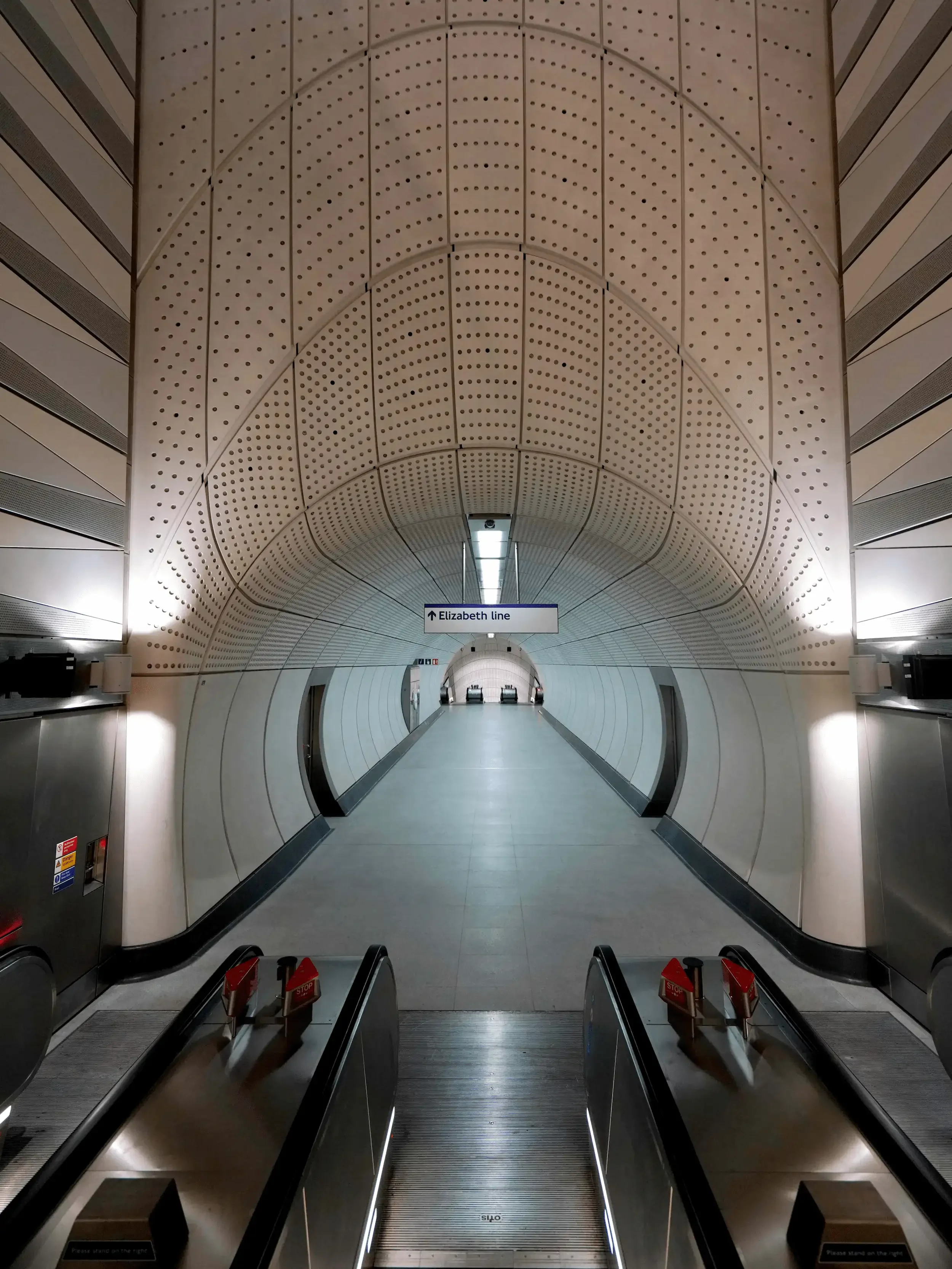

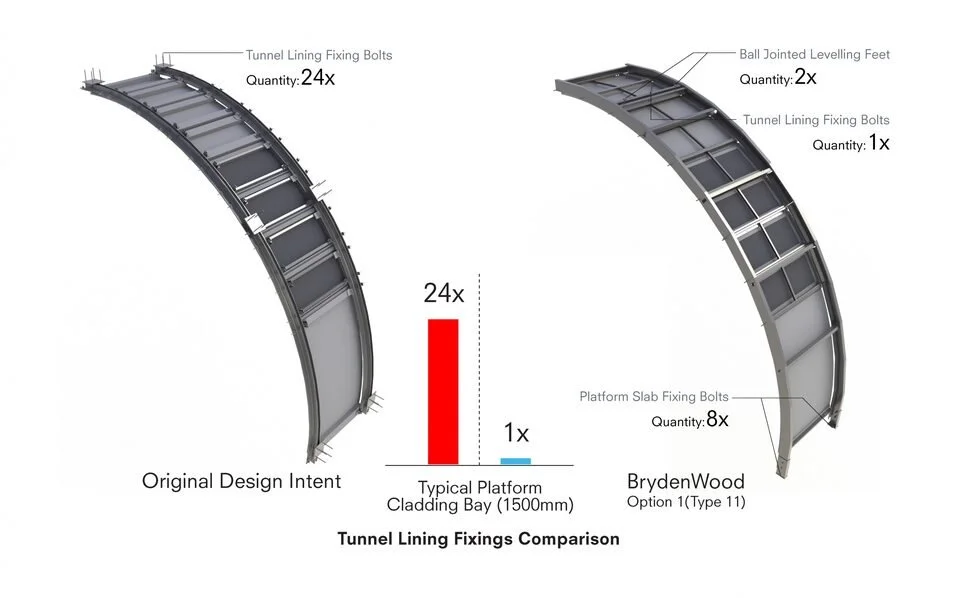


Bryden Wood was appointed by Laing O'Rourke to design the tunnel cladding system for Tottenham Court Road and Liverpool Street stations – two of the largest and most complex stations on the Elizabeth Line. The fundamental challenge was the tunnel lining itself: sprayed concrete walls with a tolerance of plus or minus 10–20mm, in narrow congested spaces with no room for heavy equipment, and 23,000 panels to install across complex 3D geometries. Bryden Wood's solution made the cladding system independent of the concrete wall entirely – a high-tolerance, factory-controlled process subject only to its own precision.
Project details:
-
-
-
Bryden Wood's 'LOR' solution was adopted by Laing O'Rourke as the preferred approach for the Elizabeth Line – and contributed to the project winning the 2024 Stirling Prize. The GFRC panels are nearly two-thirds lighter than traditional concrete, enabling two-person handling throughout and eliminating heavy lifting equipment. 96% fewer fixings and 46% fewer parts simplified installation across the full 23,000-panel scope. An entirely digital workflow eliminated fabrication drawings, maintained zero tolerance from design through CNC cutting to installation, and removed the potential for human error at every stage.
Bryden Wood developed the design and installation principles for the tunnel lining system at Tottenham Court Road and Liverpool Street – two of the largest and most complex stations on the Elizabeth Line. The stations required architectural solutions that were visually striking, aligned with Transport for London's design standards, and precisely integrated with structural, mechanical, and electrical systems throughout.
The fundamental challenge was the tunnel lining itself: sprayed concrete walls with a tolerance of plus or minus 10–20mm, in narrow, congested spaces with no room for heavy equipment or material storage. Bryden Wood's solution took the lining largely independent from the concrete wall, creating a high-tolerance, factory-controlled system subject only to its own precision. Panel installation resembled an assembly line, with tolerances predetermined at the design stage and maintained through CNC cutting and forming. The cladding system needed to sit within 250mm of the wall, a significant constraint when holding several tonnes of material.
The GFRC panels' reduced weight enabled two-person handling throughout, eliminating the need for heavy lifting equipment in spaces where it could not be used anyway. Parametric and digital tools allowed rapid testing of design iterations and ensured panels fitted precisely with escalators, platforms, and service ducts throughout, coordinated components manufactured off-site and installed with minimal disruption to ongoing construction.
The Elizabeth Line was awarded the RIBA Stirling Prize 2024 – the UK's most prestigious architecture award – recognised as a 'flawless' example of collaborative infrastructure design across its 62-mile network.
Bryden Wood's cladding system for the station access tunnels at Tottenham Court Road, Liverpool Street, and Whitechapel also won four awards at the GRC Congress 2023, including the top prize alongside Best Engineering GRC Application/Product and Best Use of GRC in a New Build Project.
The Elizabeth Line cladding was not a conventional construction problem. It was a manufacturing problem, solved with manufacturing thinking. Bryden Wood’s ‘LOR’ solution – 23,000 panels, 58% lighter, 96% fewer fixings, and an entirely digital workflow that contributed to the RIBA 2024 Stirling Prize.